|
Type
|
Reference
|
Content
|
|
web
|
www.mitre.org
|
MITRE: https://www.mitre.org/
|
|
web
|
browser.ihtsdotools.org
|
http://snomed.info/sct
|
|
web
|
www.mitre.org
|
IG © 2025+ MITRE
. Package cancerscreeningcds.fhir.us.bcsm-cds#1.0.0 based on FHIR 4.0.1
. Generated 2025-02-28
Links: Table of Contents |
QA Report
|
|
web
|
jamanetwork.com
|
https://jamanetwork.com/journals/jama/fullarticle/2463262
|
|
web
|
www.uspreventiveservicestaskforce.org
|
https://www.uspreventiveservicestaskforce.org/uspstf/recommendation/breast-cancer-screening
|
|
web
|
www.cancer.org
|
https://www.cancer.org/cancer/types/breast-cancer/screening-tests-and-early-detection/american-cancer-society-recommendations-for-the-early-detection-of-breast-cancer.html
|
|
web
|
acsjournals.onlinelibrary.wiley.com
|
https://acsjournals.onlinelibrary.wiley.com/doi/full/10.3322/canjclin.57.2.75
|
|
web
|
www.breastsurgeons.org
|
https://www.breastsurgeons.org/docs/statements/asbrs-rg-high-risk-lesions.pdf
|
|
web
|
www.breastsurgeons.org
|
https://www.breastsurgeons.org/docs/statements/asbrs-rg-excisional-breast-biopsy.pdf
|
|
web
|
edge.sitecorecloud.io
|
https://edge.sitecorecloud.io/americancoldf5f-acrorgf92a-productioncb02-3650/media/ACR/Files/RADS/BI-RADS/Mammography-Reporting.pdf
|
|
web
|
edge.sitecorecloud.io
|
https://edge.sitecorecloud.io/americancoldf5f-acrorgf92a-productioncb02-3650/media/ACR/Files/RADS/BI-RADS/Breast-MRI-Reporting.pdf
|
|
web
|
edge.sitecorecloud.io
|
https://edge.sitecorecloud.io/americancoldf5f-acrorgf92a-productioncb02-3650/media/ACR/Files/RADS/BI-RADS/Breast-Ultrasound-Reporting.pdf
|
|
web
|
www.uspreventiveservicestaskforce.org
|
https://www.uspreventiveservicestaskforce.org/uspstf/recommendation/brca-related-cancer-risk-assessment-genetic-counseling-and-genetic-testing
|
|
web
|
www.uspreventiveservicestaskforce.org
|
https://www.uspreventiveservicestaskforce.org/uspstf/recommendation/breast-cancer-medications-for-risk-reduction
|
|
web
|
tools.bcsc-scc.ucdavis.edu
|
https://tools.bcsc-scc.ucdavis.edu/BC5yearRisk
|
|
web
|
www.jacr.org
|
https://www.jacr.org/article/S1546-1440(21)00730-4/fulltext
|
|
web
|
transcare.ucsf.edu
|
https://transcare.ucsf.edu/guidelines/breast-cancer-women
|
|
web
|
cancerscreeningcds.github.io
|
See here
for logic path L2 representation.
|
|
web
|
cancerscreeningcds.github.io
|
See here
for logic path L2 representation.
|
|
web
|
cancerscreeningcds.github.io
|
See here
for logic path L2 representation.
|
|
web
|
cancerscreeningcds.github.io
|
See here
for logic path L2 representation.
|
|
web
|
cancerscreeningcds.github.io
|
See here
for logic path L2 representation.
|
|
web
|
smarthealthit.org
|
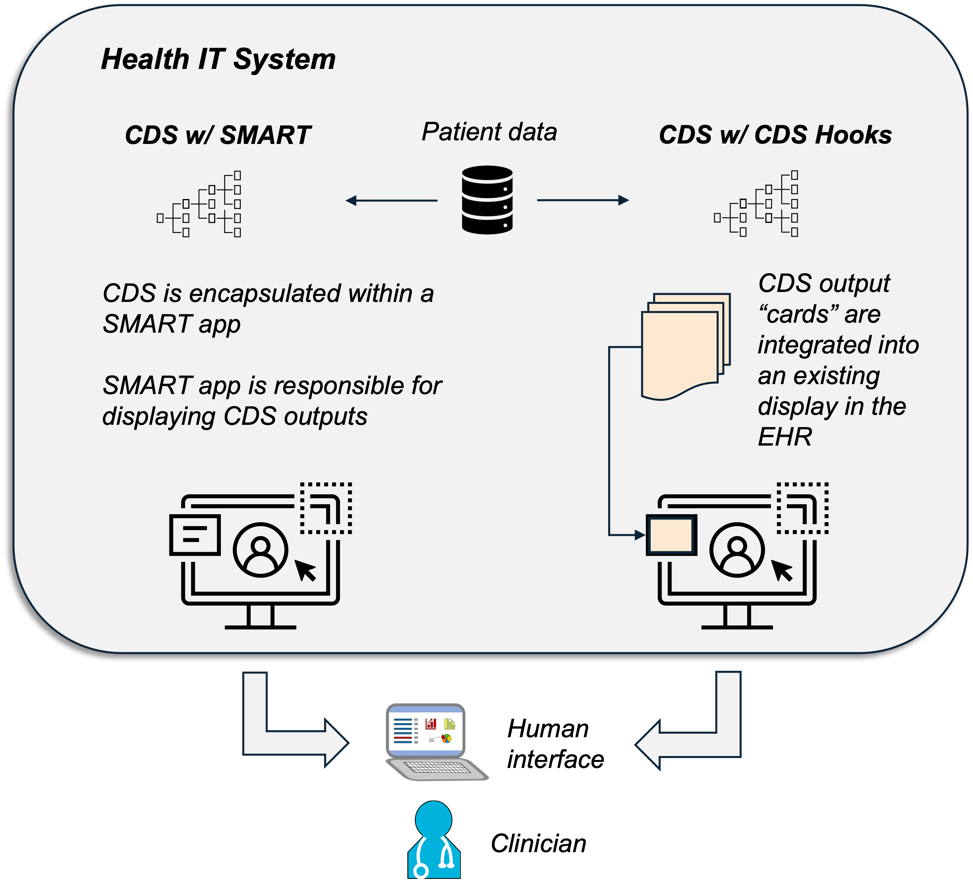
The Sustainable Medical Applications, Reusable
Technologies
(SMART ®
) standard
facilitates the integration of software applications, or "apps," with
health IT systems. "SMART on FHIR apps," or sometimes simply "SMART
apps," are software applications that securely interact with patient
EHRs and other healthcare-related data via a FHIR API. SMART apps are
interoperable in the sense that they can interface with any health IT
system that supports the SMART standard and the data requirements of the
app. Instead of writing a separate software application to provide the
same capability for each different health IT system, a single
application can be written that works with many different health IT
systems.
|
|
web
|
cds-hooks.org
|
The CDS Hooks standard
describes how CDS
services, which are simply software that provide CDS, can be integrated
with health IT systems. While SMART is more general in nature, CDS Hooks
focuses on integrating
CDS into the clinician workflow. This is accomplished through the use of
a number of so-called "hooks," which is a software term for a technique
for altering the behavior of a software program. CDS Hooks focuses on
how CDS recommendations can be sent to a health IT system via
informational "cards." In contrast with SMART, a CDS Hooks integration
would typically assume that some other system ( e.g.
, the health IT
system) would be responsible for displaying the information in these
cards to the clinician. This distinction is discussed further in the
next section.
|
|
web
|
en.wikipedia.org
|
The CDS Hooks standard
describes how CDS
services, which are simply software that provide CDS, can be integrated
with health IT systems. While SMART is more general in nature, CDS Hooks
focuses on integrating
CDS into the clinician workflow. This is accomplished through the use of
a number of so-called "hooks," which is a software term for a technique
for altering the behavior of a software program. CDS Hooks focuses on
how CDS recommendations can be sent to a health IT system via
informational "cards." In contrast with SMART, a CDS Hooks integration
would typically assume that some other system ( e.g.
, the health IT
system) would be responsible for displaying the information in these
cards to the clinician. This distinction is discussed further in the
next section.
|
|
web
|
www.uspreventiveservicestaskforce.org
|
USPSTF United States Preventive Services Task Force, "Breast
Cancer: Screening," 11 January 2016. [Online]. Available:
https://www.uspreventiveservicestaskforce.org/uspstf/recommendation/breast-cancer-screening
.
|
|
web
|
www.uspreventiveservicestaskforce.org
|
USPSTF United States Preventive Services Task Force, "Colorectal
Cancer: Screening," 18 May 2021. [Online]. Available:
https://www.uspreventiveservicestaskforce.org/uspstf/recommendation/colorectal-cancer-screening
|
|
web
|
www.uspreventiveservicestaskforce.org
|
2024 U.S. Preventive Services Task Force Recommendation Statement:
Screening for Breast Cancer
|
|
web
|
www.acog.org
|
American College of Obstetricians and Gynecologists (ACOG):
Practice Bulletin on Breast Cancer Risk Assessment and Screening in
Average-Risk
Women
|
|
web
|
jamanetwork.com
|
American Cancer Society (ACS): Guideline on Breast Cancer
Screening for Women at Average Risk,
Update
|
|
web
|
www.nccn.org
|
NCCN Guidelines: Breast Cancer Screening and Diagnosis, Version
2.2023
|
|
web
|
acsearch.acr.org
|
ACR: ACR Appropriateness Criteria on Breast Cancer
Screening
|
|
web
|
www.uspreventiveservicestaskforce.org
|
U.S. Preventive Services Task Force (USPSTF): Final Recommendation
Statement on BRCA-Related Cancer: Risk Assessment, Genetic
Counseling, and Genetic
Testing
|
|
web
|
www.uspreventiveservicestaskforce.org
|
USPSTF Recommendation: Breast Cancer: Medication Use to Reduce
Risk
|
|
web
|
acsjournals.onlinelibrary.wiley.com
|
American Cancer Society Guidelines for Breast Screening with MRI
as an Adjunct to
Mammography
|
|
web
|
www.cancer.org
|
ACS Breast Cancer Screening
Guidelines
|
|
web
|
www.acog.org
|
American College of Obstetricians and Gynecologists (ACOG):
Practice Bulletin on Hereditary Cancer Syndromes and Risk
Assessment
|
|
web
|
www.nccn.org
|
NCCN Guidelines: Breast Cancer Risk Reduction, Version
2.2024
|
|
web
|
www.nccn.org
|
NCCN Guidelines: Genetic/Familial High-Risk Assessment: Breast,
Ovarian, and Pancreatic, Version
3.2024
|
|
web
|
www.breastsurgeons.org
|
The American Society of Breast Surgeons Resource Guide: Excisional breast biopsy (November 2014)
|
|
web
|
www.breastsurgeons.org
|
The American Society of Breast Surgeons Resource Guide: Surgical Management of Benign or High-Risk Lesions (Feb 2025)
|
|
web
|
cancerscreeningcds.github.io
|
The CDS L2 documentation for breast cancer guidelines can be found at this location: Introduction | CDC Breast Cancer Screening CDS L2
|
|
web
|
www.apache.org
|
The L3 CDS definitions have been released under an Apache 2.0
open-source license
and
are available in this repository. The Apache 2.0 license was chosen for
the L3 CDS because it is generally considered to be permissive and
friendly to commercial reuse of the software being licensed. Releasing
the L3 CDS definitions under an Apache 2.0 license means that it can be
freely incorporated into other software and systems, which can in turn
be redistributed to others without permission from the L3 CDS authors.
Conditions of the Apache 2.0 license include attribution requirements
and lack of liability and/or warranty.
|
|
web
|
github.com
|
Recall from Section 3.3.1.4
that the human readable version of CQL must be
converted or translated to the computer friendly format (i.e., ELM)
before it can be used as a part of CDS software. The CQL-to-ELM
Translator
Reference Implementation is an open source software package written in
the Java programming language. It has been used to translate the BCSM
CDS CQL, which as a by-product checks the CQL for conformance to the CQL
specification. As with the FHIR Validator, this tool checks to make sure
what has been written is, from a software standpoint, "grammatically
correct." It does not provide any insight into whether the CQL code, as
written, correctly implements the intended CDS logic.
|
|
web
|
github.com
|
Once CQL code has been translated into a computer friendly format, it
additionally needs software to "execute" or "run" the result in the
context of a patient's electronic health record. Executing CQL in this
way is necessary to support both Unit and End-to-End Testing. Multiple
open-source CQL "execution engines" exist; the BCSM CDS has been unit
tested using the CQL Execution
Framework
Reference Implementation, a software library written in the JavaScript programming
language. Additional JavaScript libraries are used to help interface
with FHIR data
and to
handle clinical codes and value
sets
. For End-to-End Testing, an asynchronous library called CQL
Workers
is used for computational speed reasons.
|
|
web
|
github.com
|
Once CQL code has been translated into a computer friendly format, it
additionally needs software to "execute" or "run" the result in the
context of a patient's electronic health record. Executing CQL in this
way is necessary to support both Unit and End-to-End Testing. Multiple
open-source CQL "execution engines" exist; the BCSM CDS has been unit
tested using the CQL Execution
Framework
Reference Implementation, a software library written in the JavaScript programming
language. Additional JavaScript libraries are used to help interface
with FHIR data
and to
handle clinical codes and value
sets
. For End-to-End Testing, an asynchronous library called CQL
Workers
is used for computational speed reasons.
|
|
web
|
github.com
|
Once CQL code has been translated into a computer friendly format, it
additionally needs software to "execute" or "run" the result in the
context of a patient's electronic health record. Executing CQL in this
way is necessary to support both Unit and End-to-End Testing. Multiple
open-source CQL "execution engines" exist; the BCSM CDS has been unit
tested using the CQL Execution
Framework
Reference Implementation, a software library written in the JavaScript programming
language. Additional JavaScript libraries are used to help interface
with FHIR data
and to
handle clinical codes and value
sets
. For End-to-End Testing, an asynchronous library called CQL
Workers
is used for computational speed reasons.
|
|
web
|
github.com
|
Once CQL code has been translated into a computer friendly format, it
additionally needs software to "execute" or "run" the result in the
context of a patient's electronic health record. Executing CQL in this
way is necessary to support both Unit and End-to-End Testing. Multiple
open-source CQL "execution engines" exist; the BCSM CDS has been unit
tested using the CQL Execution
Framework
Reference Implementation, a software library written in the JavaScript programming
language. Additional JavaScript libraries are used to help interface
with FHIR data
and to
handle clinical codes and value
sets
. For End-to-End Testing, an asynchronous library called CQL
Workers
is used for computational speed reasons.
|
|
web
|
github.com
|
The CQL Testing
Framework
is a JavaScript
software library that facilitates Unit Testing of CQL code. While
leveraging the CQL Execution Framework Reference Implementation, it
provides a convenient short-hand notation for defining test cases. The
CQL Testing Framework also automates the process of running the test
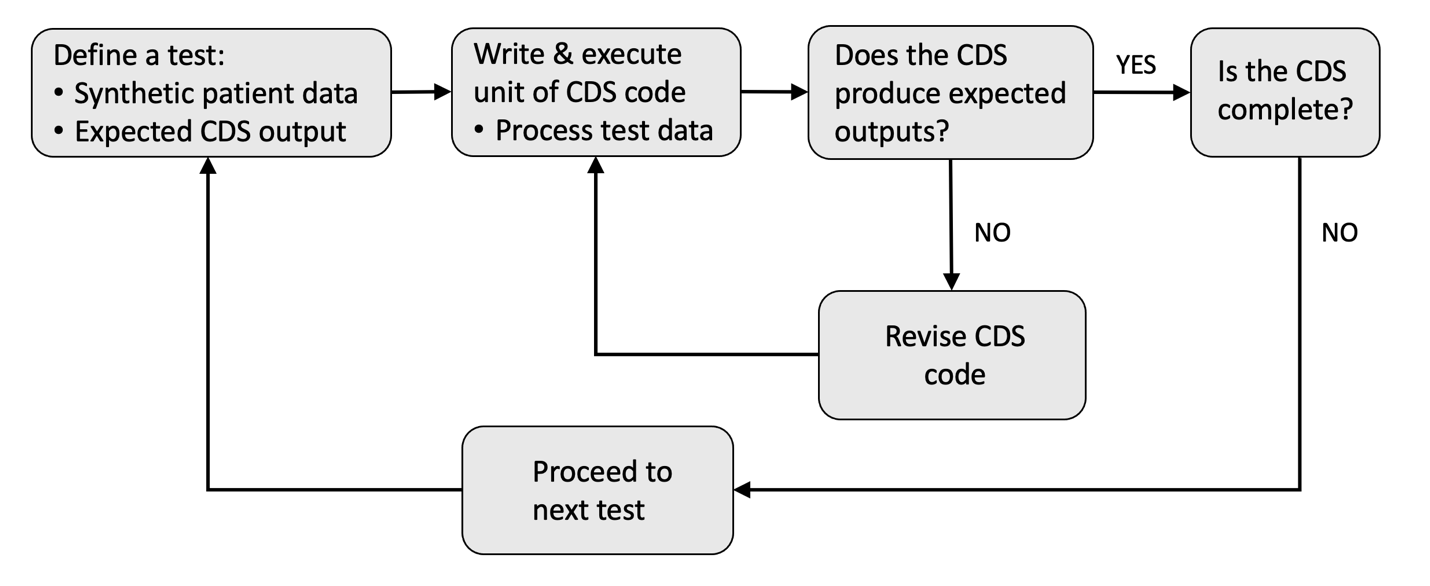
cases, which greatly increases the efficiency of TDD of CDS. All Unit
Tests were developed through the use of the CQL Testing Framework. The
complete specifications for all test cases were released under an
open-source license.
|
|
web
|
synthetichealth.github.io
|
While the CQL Testing Framework allows simple test cases to be easily
defined, it is less well suited for defining large numbers of test cases
or complex test cases.
Synthea
is a mature open
source tool for simulating large amounts of synthetic health record
data. It has the option of outputting data as FHIR resources, which
makes it suitable for use with testing interoperable CDS. For Synthea to
be able to generate suitable BCSM data, a breast cancer "disease
module"
must first be defined. A Synthea disease module is a directed graph that
defines what types of health data must be simulated and the dependencies
or constraints placed on that data.
|
|
web
|
synthetichealth.github.io
|
While the CQL Testing Framework allows simple test cases to be easily
defined, it is less well suited for defining large numbers of test cases
or complex test cases.
Synthea
is a mature open
source tool for simulating large amounts of synthetic health record
data. It has the option of outputting data as FHIR resources, which
makes it suitable for use with testing interoperable CDS. For Synthea to
be able to generate suitable BCSM data, a breast cancer "disease
module"
must first be defined. A Synthea disease module is a directed graph that
defines what types of health data must be simulated and the dependencies
or constraints placed on that data.
|
|
web
|
github.com
|
"Encender"
is a software
library written in the JavaScript programming language that implements
the FHIR $apply operation. It has been developed for the specific
purpose of testing the BCSM CDS but is also general in that it can be
used with other CDS. The name "Encender," which is also the Spanish word
for "to light or turn on," was chosen because the software allows FHIR
resources representing CDS to be applied to a specific patient's
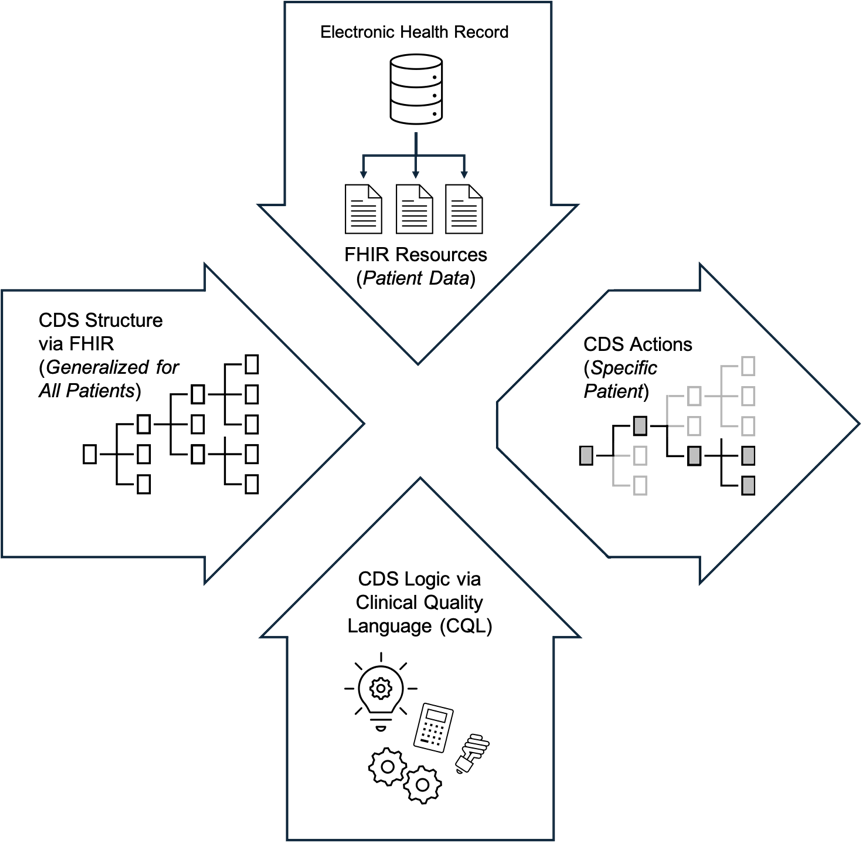
electronic health data. As shown in Figure 2 and discussed in Section 3.3.4
,
the output from the FHIR $apply operation, and thus the Encender
library, includes the CDS recommended actions for a specific patient.
This makes Encender a critical tool for End-to-End Testing; it uses the
CQL Workers library for CQL code execution. Encender has been released
as open source software.
|