Breast Cancer Screening and Management (BCSM) Clinical Decision Support (CDS) Implementation Guide - Local Development build (v1.0.0) built by the FHIR (HL7® FHIR® Standard) Build Tools. See the Directory of published versions
Specification
Clinical Guidelines Evidence Base
Based on the literature search, informant interviews, and review of the guideline evidence base, the CDS tools will be designed to represent the USPSTF guidelines for screening average risk individuals. Additional guidelines will be applied for managing abnormal screening results and increased or high-risk individuals. The list below is representative of the primary guidelines that will be used to develop the CDS but may not represent a comprehensive list of every evidence-based reference. A complete set of guidelines and references will be documented as we develop the logical representation for the CDS.
Breast Cancer CDS Evidence Base
Average Risk Breast Cancer Screening
-
2024 U.S. Preventive Services Task Force Recommendation Statement: Screening for Breast Cancer
-
NCCN Guidelines: Breast Cancer Screening and Diagnosis, Version 2.2023
-
ACR: ACR Appropriateness Criteria on Breast Cancer Screening
Higher than Average Risk Breast Cancer Screening
-
USPSTF Recommendation: Breast Cancer: Medication Use to Reduce Risk
-
American Cancer Society Guidelines for Breast Screening with MRI as an Adjunct to Mammography
-
NCCN Guidelines: Breast Cancer Screening and Diagnosis, Version 2.2023
-
NCCN Guidelines: Breast Cancer Risk Reduction, Version 2.2024
-
NCCN Guidelines: Breast Cancer Screening and Diagnosis, Version 2.2023
Management of Abnormal Breast Cancer Screening Results
-
NCCN Guidelines: Breast Cancer Screening and Diagnosis, Version 2.2023
-
The American Society of Breast Surgeons Resource Guide: Excisional breast biopsy (November 2014)
Overview of the CDS L2 Representation
The CDS Level 2 (L2) includes a semi-structured representation of evidence-based narrative guidelines for breast and colorectal cancer screening. Semi-structured representation of guideline content and recommendations is essential for the development of computable clinical decision support (CDS) artifacts. It includes:
-
High-level and mid-level flow diagrams that visually illustrate portions of the guidelines.
-
A brief description of each portion of the CDS logic.
-
Semi-structured logic statements that list required clinical concepts, inclusion criteria, exclusion criteria, events (decision points), and actions (output, e.g. recommendations).
The high-level flow diagram identifies several different patient populations based on a patient’s symptoms, past medical history and previous screening results. The flow diagram also points to the corresponding guidelines that outline how that patient should be cared for. The mid-level flow diagram (which is divided across several pages) provides a more detailed view of the logic. It describes how population criteria are defined and decision points that identify relevant guidelines and patient-specific recommendations.
The CDS L2 documentation for breast cancer guidelines can be found at this location: Introduction | CDC Breast Cancer Screening CDS L2
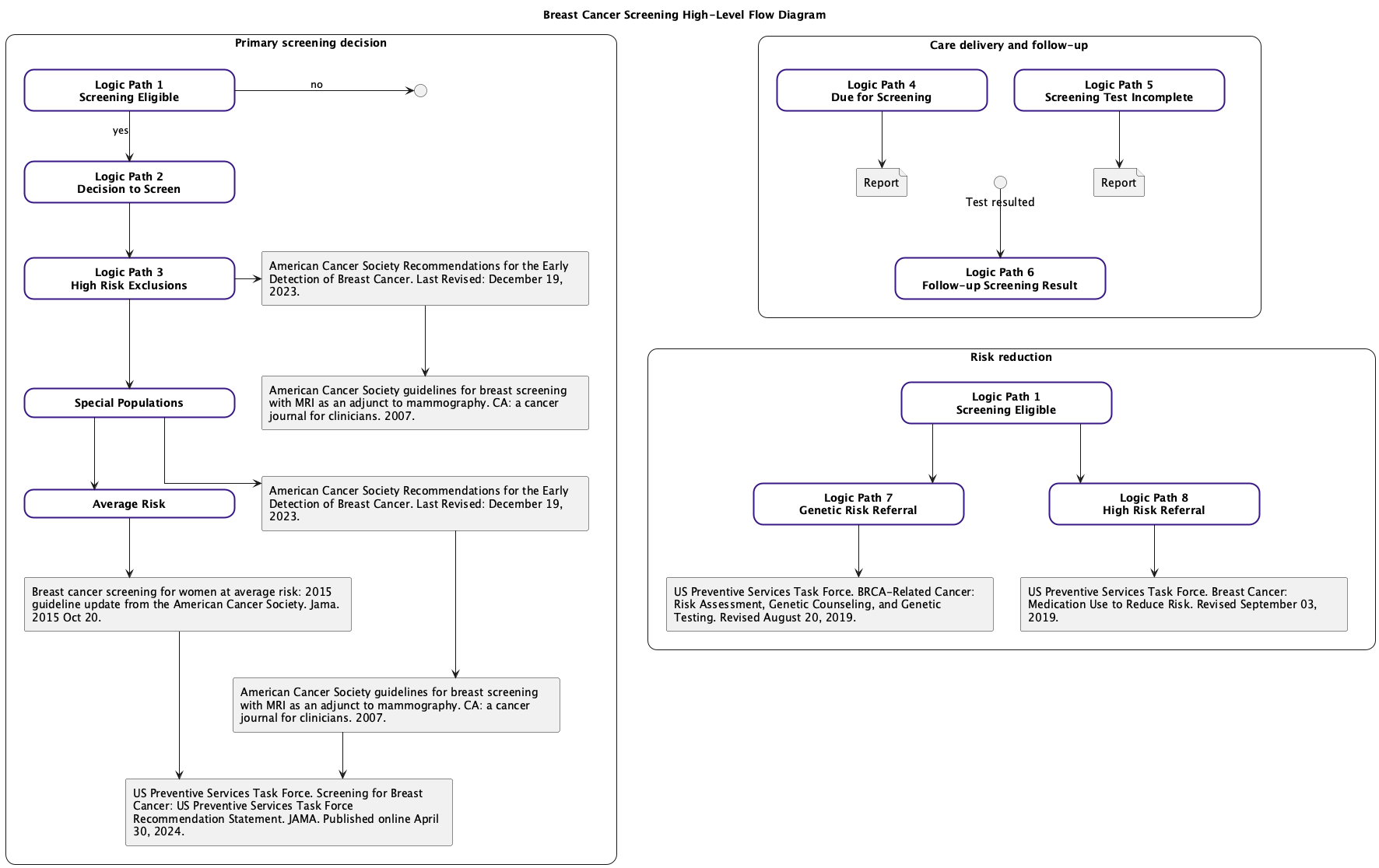
Figure 1: High-Level Flow Diagram.
Overview of the L3 CDS Representation
The L3 CDS is expressed in a computer-interpretable format using health information technology (IT) interoperability standards. For health IT systems that support the underlying interoperability standards, implementation burden is eased when compared to their own version from scratch based upon the L2 CDS. This section describes the health IT standards used to define the L3 CDS. These standards are used to define both the structure of the BCSM CDS as well as the computer logic needed to provide customized recommendations for each patient. A high-level conceptual description, with examples, is provided for how the BCSM CDS is to be used in practice. This section closes with a link to the open-source computer software that comprises the L3 CDS definition.
Interoperability Standards for CDS Definition
Multiple health IT interoperability standards are used to define the L3 CDS. These standards are introduced in this section, alongside rationale for why they have been selected for use as the technical foundation of the L3 CDS definition.
Fast Healthcare Interoperability Resources (FHIR®)
Fast Healthcare Interoperability Resources (FHIR®) is an international IT standard for representing and exchanging healthcare information electronically. FHIR provides general data structures or "resources" for representing a variety of clinical and healthcare-related data. Example resource types include Condition and Observation, which can respectively be used to represent clinical diagnoses and laboratory test results. FHIR resources are, by design, general in nature so that they can support the majority of real-world use cases. But FHIR also allows each resource to be customized for specific applications; these customizations can themselves be standardized through the use of FHIR extensions, profiles, and implementation guides.
This customizability and flexibility are some of the reasons why FHIR has been growing in popularity despite being a relatively new standard. The use of FHIR in the United States is expected to continue to grow because it is the basis for the application programming interface (API) required by the 21st Century Cures Act Interoperability Final Rule. It is for these reasons, flexibility and availability, that FHIR has been selected for use in the L3 CDS definition. Section 3.3.2 discusses the specific FHIR resources used to define the structure of the BCSM CDS.
FHIR Clinical Reasoning Module
The Clinical Reasoning Module (CRM) is a subset of the base FHIR standard. The CRM provides the FHIR resources and operations needed for representing and distributing clinical knowledge tools such as CDS. The structure of the BCSM CDS described in this document is based upon the guidance provided by the CRM for designing and building CDS. Section 3.3.4 references the CRM while discussing conceptual usage of the BCSM CDS.
FHIR Clinical Guidelines Implementation Guide
The FHIR Clinical Guidelines implementation guide (IG), also known as "Clinical Practice Guidelines (CPG) on FHIR," provides an approach and methodology for representing the intent of clinical guidelines as computable CDS. The BCSM CDS was developed by following the best practices outline in the CPG on FHIR IG. These best practices include testing and validation of the BCSM CDS application, which is described in Section 3.4. In addition, several extensions and profiles defined in the CPG on FHIR IG have been used in the L3 CDS representation.
Clinical Quality Language
The Clinical Quality Language (CQL) is a domain-specific computer programming language focused on the expression of clinical quality concepts. It can be used to author CDS logic and is designed to interface with the other standards described in this section. That latter fact constitutes one of CQL's advantages over other more general-purpose programming languages when it comes to authoring CDS logic. An additional advantage is that CDS logical expressions written with CQL tend to read more like natural language than as a computer program, making CQL more accessible to audiences outside the realm of software development.
Computer code written in CQL is human readable but can be translated or "compiled" into a more structured format that is interpretable by computers. This computer-friendly format is called the Expression Logical Model (ELM), and it is this format of the logic that is interpreted when the CDS logic is executed against patient data. Conversion from CQL to ELM is part of an initial type of testing described in Section 3.4.3.2.
CDS Structure via FHIR
The FHIR standard defines numerous types of data structures called resources, several of which are used to define the structure of the L3 CDS:
-
PlanDefinition - Used to define and describe groups of actions that occur under certain circumstances; these groups of actions represent the overall structure of the L3 CDS. Each action may reference FHIR resources including other PlanDefinition resources.
-
ActivityDefinition - Used to define and describe a single activity, such as a request for a laboratory test or for a communication to be sent to a provider.
-
Questionnaire - Used to define forms that can be presented to the CDS user to obtain additional information when necessary.
-
Library - Used to package the CDS logic, which is referenced by the other FHIR resources and expressed using CQL.
Both the Screening CDS and Management CDS are represented as nested sets of the above FHIR resources.
CDS Logic via CQL
While FHIR allows the structure of the BCSM CDS to be described, it can only enumerate the set of all actions that could apply to any patient. The CQL standard allows CDS logic to be expressed so that it can be determined which actions apply to a specific patient. As described in Section 3.3.3, CQL allows the BCSM CDS logic to be written as computer code that implements the following capabilities:
-
Query patient electronic health record (EHR) for pertinent medical history
-
Aggregate and sort pertinent medical history for presentation to the clinician on a dashboard
-
Apply inclusion and exclusion logic to determine what actions of the CDS should apply to a particular patient
-
Generate structured recommendations for the patient when appropriate
-
Identify errors and communicate them to the clinician via meaningful notifications
Conceptual CDS Usage
The following section describes at a high level how the BCSM CDS application is meant to be used in practice. The discussion here is notional and informed by both the FHIR CRM as well as the CPG on FHIR IG. Implementation details are not considered; see Section 2.4 for information about the software needed to implement the CDS for practical usage.
FHIR $apply Operation
As described in previous sections, the structure of the BCSM CDS is defined by a set of FHIR resources. The structural FHIR resources primarily include PlanDefinition and ActivityDefinition; these resources come from the CRM and describe actions or groups of actions that are general and patient agnostic (that is, they have not been customized for any particular patient). The CRM provides an operation called "$apply," which transforms these patient-agnostic resources into other FHIR resources which are customized for a particular patient. This is accomplished by evaluating CDS logic, expressed using CQL, in the context of the patient electronical health record. Figure 2 below illustrates the process behind the $apply operation; two notional examples are provided in the following section.
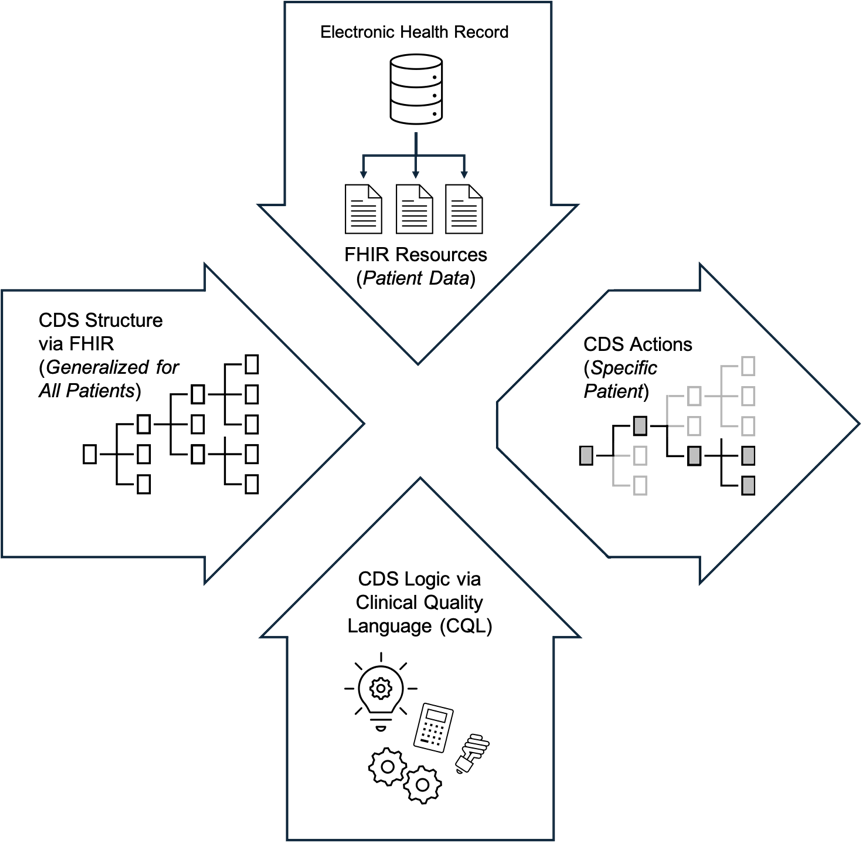
Figure 2: Illustration of the FHIR $apply operation.
CDS L3 Source Code
The L3 CDS definitions have been released under an Apache 2.0 open-source license and are available in this repository. The Apache 2.0 license was chosen for the L3 CDS because it is generally considered to be permissive and friendly to commercial reuse of the software being licensed. Releasing the L3 CDS definitions under an Apache 2.0 license means that it can be freely incorporated into other software and systems, which can in turn be redistributed to others without permission from the L3 CDS authors. Conditions of the Apache 2.0 license include attribution requirements and lack of liability and/or warranty.
CDS Testing & Validation
Testing is a critical step in the CDS development process; it is necessary to test a CDS to ensure that it faithfully implements the clinical logic as intended by the underlying guidelines. CDS testing follows an approach similar to what is used for testing computer software. This should come as no surprise since CDS can be thought of as a very specialized computer program. The following section outlines the testing methodology that has been used with the BCSM CDS. The role of testing in CDS development is first described and then the different types of testing are discussed. This section closes with a listing of the computer software tools used as part of the BCSM CDS testing process.
Test Driven Development (TDD)
The BCSM CDS has been developed using what is known in the computer software domain as test driven development (TDD). With TDD, test cases are first created before any CDS software ("code") is written. Each test case consists of a set of synthetic patient health data represented as FHIR resources as well as a specification for what the CDS outputs are expected to be. Once a test case is created, just enough CDS code is written so that the test passes (meaning the CDS outputs agree with the expected values). If a test case fails, the CDS code must be updated until the test case passes. This process of defining a test case and then writing a portion or "unit" of the CDS software continues until the code is deemed to be complete. The rationale for TDD is that it is expected that the resulting computer code will have fewer defects ("bugs") than would normally exist in comparable software. Figure 3 shows a diagram depicting the test-driven approach used for developing the BCSM CDS application.
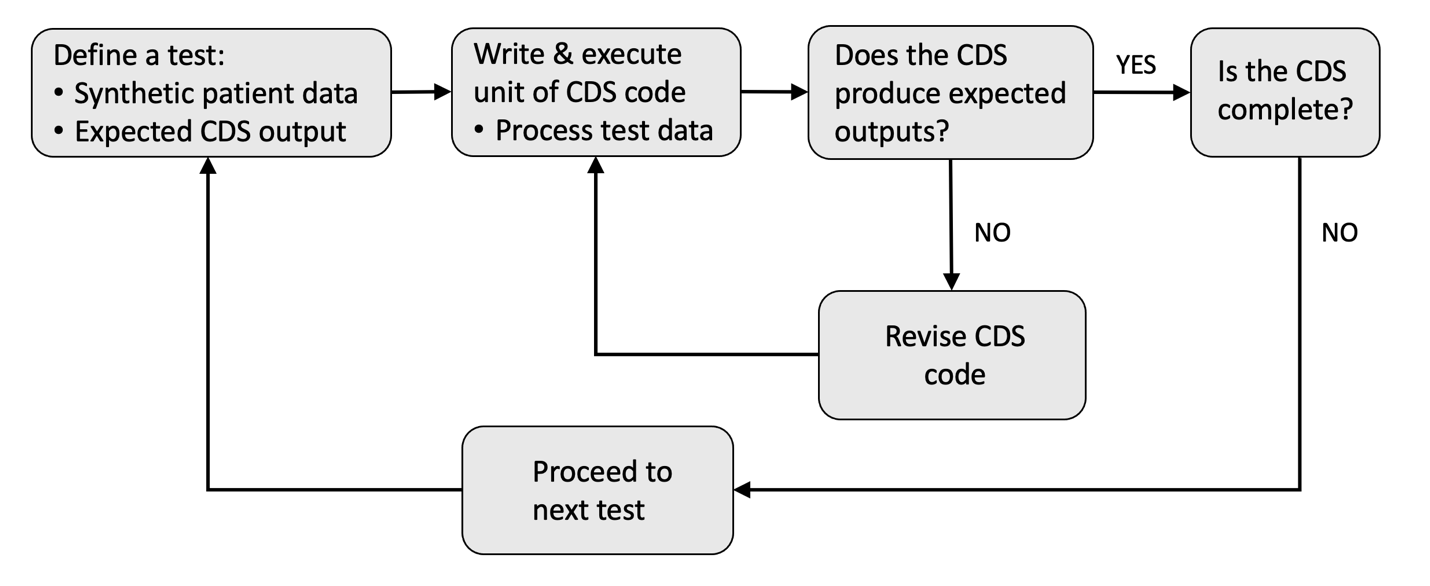
Figure 3: Illustration of test-driven approach for developing the BCSM CDS.
Types of Testing
This section discusses the different types of testing used while the BCSM CDS application was developed. The types of tests start with simple formatting checks, progress to tests on the individual units of CDS logic, and finally conclude with the most representative type of testing which involves running the CDS software "end-to-end." Each type of testing requires different supporting software tools, which are described in detail in Section 3.4.3.
Specification Testing
Specification testing involves checking the CDS definition files to ensure they conform to the underlying specification(s). In the case of FHIR resources used to define the structure of the CDS, this entails checking that each are valid according to the FHIR specification. For CDS logic encoded using CQL, this means checking them for conformance with the CQL specification. The tools used for specification testing are described in Section 3.4.3.
Specification testing is important because it ensures that the CDS definitions actually are represented using interoperable standards. If the BCSM CDS definitions were to fail specification testing, it would mean they are not truly interoperable. Conversely, just because specification tests pass doesn't mean that the BCSM CDS definitions are a valid representation of the underlying clinical guidelines and evidence. To check that, a different type of testing is needed.
Unit Testing with Test Cases
CDS, as with most software, is comprised of small portions of computer code that are frequently referred to as "units." Ideally, each unit is responsible for a single piece of CDS functionality (e.g., a query for a specific type of patient electronic health information). As mentioned in the previous section, each unit of CQL logic must be verified to be valid according to the CQL specification. Once that has been verified, the functionality of the unit of CDS logic must be tested. This is accomplished by defining one or more test cases, as described in Section 3.4.1. The process of applying these test cases to computer code is called "unit testing."
Each test case consists of synthetic electronic health records for a hypothetical patient as well as the corresponding expected CDS outputs. The synthetic electronic health records are specified with a set of FHIR resources while the expected CDS outputs are specified using knowledge of the underlying guidelines and on the L2 CDS. Unit testing involves running or "executing" the CQL code against the synthetic FHIR data and then comparing the output against the expected results. A unit of CQL code is not complete until all test cases referencing it pass successfully.
End-to-End Testing
Even once all units of CQL logic have been individually tested, they still must be tested together in a representative context. This is accomplished by executing the process described in Section 3.3.4.1 regarding the FHIR $apply operation. End-to-End Testing entails generating synthetic electronic health records for a hypothetical patient, processing that synthetic data using the BCSM CQL code, and using the CQL logical outputs to customize the BCSM PlanDefinition and other FHIR resources. The end result of the FHIR $apply operation is a set of FHIR resources which describe the BCSM CDS recommended actions and interventions. Once produced, these outputs can be evaluated for accuracy.
While the End-to-End Testing process may sound similar to the process used for Unit Testing, it additionally entails using the BCSM FHIR and CQL files together in concert. Also, the amount and complexity of the synthetic data is greater with End-to-End Testing and outputs typically have to be evaluated manually. These distinctions necessitate different and more complex software tools to help facilitate End-to-End Testing. Testing software is discussed in the next section.
Testing Support Tools
Numerous software tools have been developed or leveraged to help support testing of the BCSM CDS. This section describes these software tools and discuss how they are used to support CDS testing. Many of these software tools could also be used with an initial implementation of the BCSM CDS. (See Section 2.4)
FHIR Validator
The FHIR Validator is a software program written in the Java programming language and maintained by HL7. It is capable of checking FHIR resource instances to ensure they adhere to the FHIR specification. The FHIR Validator can identify errors such as misspelled element names, missing or extraneous elements, and value formatting issues. It is run manually and generates a textual report summarizing all validation errors and warnings. The FHIR resources developed for the BCSM have been checked for errors using the FHIR Validator.
CQL-to-ELM Translator
Recall from Section 3.3.1.4 that the human readable version of CQL must be converted or translated to the computer friendly format (i.e., ELM) before it can be used as a part of CDS software. The CQL-to-ELM Translator Reference Implementation is an open source software package written in the Java programming language. It has been used to translate the BCSM CDS CQL, which as a by-product checks the CQL for conformance to the CQL specification. As with the FHIR Validator, this tool checks to make sure what has been written is, from a software standpoint, "grammatically correct." It does not provide any insight into whether the CQL code, as written, correctly implements the intended CDS logic.
CQL Execution Tools
Once CQL code has been translated into a computer friendly format, it additionally needs software to "execute" or "run" the result in the context of a patient's electronic health record. Executing CQL in this way is necessary to support both Unit and End-to-End Testing. Multiple open-source CQL "execution engines" exist; the BCSM CDS has been unit tested using the CQL Execution Framework Reference Implementation, a software library written in the JavaScript programming language. Additional JavaScript libraries are used to help interface with FHIR data and to handle clinical codes and value sets. For End-to-End Testing, an asynchronous library called CQL Workers is used for computational speed reasons.
CQL Testing Framework
The CQL Testing Framework is a JavaScript software library that facilitates Unit Testing of CQL code. While leveraging the CQL Execution Framework Reference Implementation, it provides a convenient short-hand notation for defining test cases. The CQL Testing Framework also automates the process of running the test cases, which greatly increases the efficiency of TDD of CDS. All Unit Tests were developed through the use of the CQL Testing Framework. The complete specifications for all test cases were released under an open-source license.
Synthea
While the CQL Testing Framework allows simple test cases to be easily defined, it is less well suited for defining large numbers of test cases or complex test cases. Synthea is a mature open source tool for simulating large amounts of synthetic health record data. It has the option of outputting data as FHIR resources, which makes it suitable for use with testing interoperable CDS. For Synthea to be able to generate suitable BCSM data, a breast cancer "disease module" must first be defined. A Synthea disease module is a directed graph that defines what types of health data must be simulated and the dependencies or constraints placed on that data.
Encender
"Encender" is a software library written in the JavaScript programming language that implements the FHIR $apply operation. It has been developed for the specific purpose of testing the BCSM CDS but is also general in that it can be used with other CDS. The name "Encender," which is also the Spanish word for "to light or turn on," was chosen because the software allows FHIR resources representing CDS to be applied to a specific patient's electronic health data. As shown in Figure 2 and discussed in Section 3.3.4, the output from the FHIR $apply operation, and thus the Encender library, includes the CDS recommended actions for a specific patient. This makes Encender a critical tool for End-to-End Testing; it uses the CQL Workers library for CQL code execution. Encender has been released as open source software.
BCSM Dashboard Prototype
End-to-End Testing should be conducted in a representative testing environment. For the BCSM CDS, this includes displaying the CDS outputs in some sort. A prototype BCSM dashboard has been developed for testing purposes and will be made available as open source software. The BCSM Prototype Dashboard not only facilitates End-to-End Testing by making it easier to evaluate the accuracy of CDS outputs, but it also serves as a potential starting point for any clinical pilot or EHR integration of the BCSM CDS.